About
Bartley creates trustable reference works that never stop growing and improving.
Nobody reads books anymore
We are already drowning in tabs, memos, podcasts, barely-skimmed PDFs, second brains, and LLM chat histories. Asking us to make room for another chunk of dead tree that will mostly gather dust is becoming a harder and harder ask.
The objection gets stronger in fields that move quickly. Practice advances through scattered research papers, blog posts, conference talks, and hard-won examples before the vocabulary settles. The promise of the book was coherence and stability, but today the object often arrives late and already frozen in the past.
So the skeptic’s question is not whether knowledge matters. It is why publishing-house language still fits the job. If readers only search, skim, listen, ask, and return when needed, why use words like “imprint” or “edition” at all?
Not Books: BoKs
Start with Gray’s Anatomy, Black’s Law Dictionary, and Harrison’s Principles. They are sold as books, but not merely books in the casual sense. They are institutionalized Bodies of Knowledge: durable professional references that disciplines return to for shared vocabulary, citable definitions, and continuity across generations of practice.
They are still published because trust is earned over time, not generated on demand. Each work has names behind it and an editorial lineage readers can recognize. The bound artifact matters, but the deeper asset is the continuing reference: a layer that survives editions, carries institutional memory, and gives a field something stable to argue from.
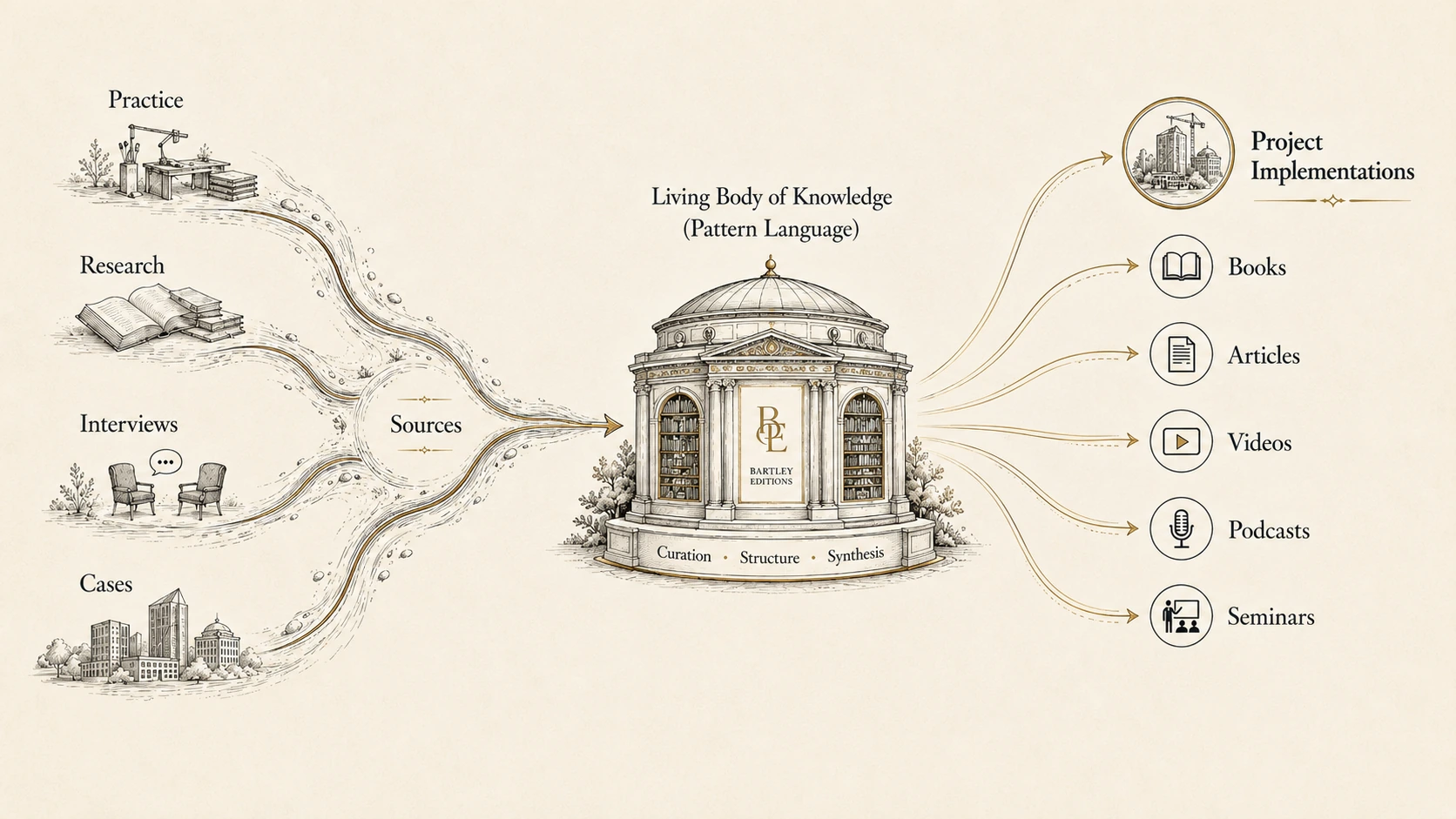
Bartley publishes that kind of thing for domains whose knowledge is diffuse and advancing. Its editions are living Body-of-Knowledge references, built around human judgment and kept current as the field changes. The Bartley engine makes that upkeep economical, so a domain that conventional publishing would not serve well can still have a serious reference.
Once the Body of Knowledge has structure, it can take many forms. The same work can support books, summaries, podcasts, video, interactive modules, and seminars.
The roles
- Curator.
- The curator brings voice, judgment, and reputation to the work. The public authority behind an edition is a person whose standing in the field is recognized independently of Bartley.
- Sponsors.
- Sponsors help sustain the work and its improvement. Readers should not have to guess who helped make an edition possible.
The engine
Behind every edition is the Bartley engine: a self-improving system of AI agents that helps produce and maintain the work under the curator’s direction. Work that once required large editorial staffs and decade-long revision cycles can now continue through the edition’s whole life.
The curator steers; the engine keeps the work moving; the imprint holds the result to one editorial standard. That is how Bartley keeps large reference works current and consistent.
Two readers, one form
Bartley editions serve two primary kinds of readers. The first is the working practitioner already in the field — the engineer, the clinician, the diplomat, the family-office principal who wants the definitive reference at hand.
The second is shaped by a labor-market reality. As AI compresses the lower rungs of craft, capable people are being asked to make decisions in fields where they have not had a full apprenticeship. A founder enters pharma compliance. A family-office manager moves into impact-first capital. A career-switcher takes a job two rungs above the work they have done. They do not need to perform the field’s manual craft; they need its executive fluency: the vocabulary and distinctions to ask good questions, the tradeoffs and failure modes to judge work, and the decision grammar to direct it. A pattern language gives them that conceptual map. The practitioner uses it for depth; the newcomer uses it for orientation. The form does not change.
In a world of abundant machine-generated text, there are five properties that make a Bartley edition trustworthy:
- A named, reputable curator
- Visible sponsor support
- Transparent standards
- Extensive sourcing
- A public revision history
A body of knowledge worth cataloging
Not every domain is a candidate for a Bartley edition. The ones that are share three properties: the knowledge is diffuse, scattered across blog posts, white papers, internal lore, conference talks, and gray literature; it is advancing, with a frontier that outpaces any conventional publisher; and it needs focus, because today’s practitioners read in fragments where a structural map would let them orient.
These are domains in which the absence of a definitive reference is a felt problem — a working professional opening the BoK and saying, this is what we have been missing. Frontier technical fields qualify, as do emerging financial and governance disciplines. Multidisciplinary and interdisciplinary practices that have no single home in the academy are also excellent candidates.
Why Bartley
The imprint is named for W. W. Bartley III (1934–1990), the philosopher who originated Pancritical Rationalism: the view that no commitment is above criticism, including the standards by which criticism proceeds. The engine is built on that idea. It improves the work, reflects on and improves its own methods, and lets the curator revise the standards it works under. Most readers will never need to think about the process; the work is what they came for.