
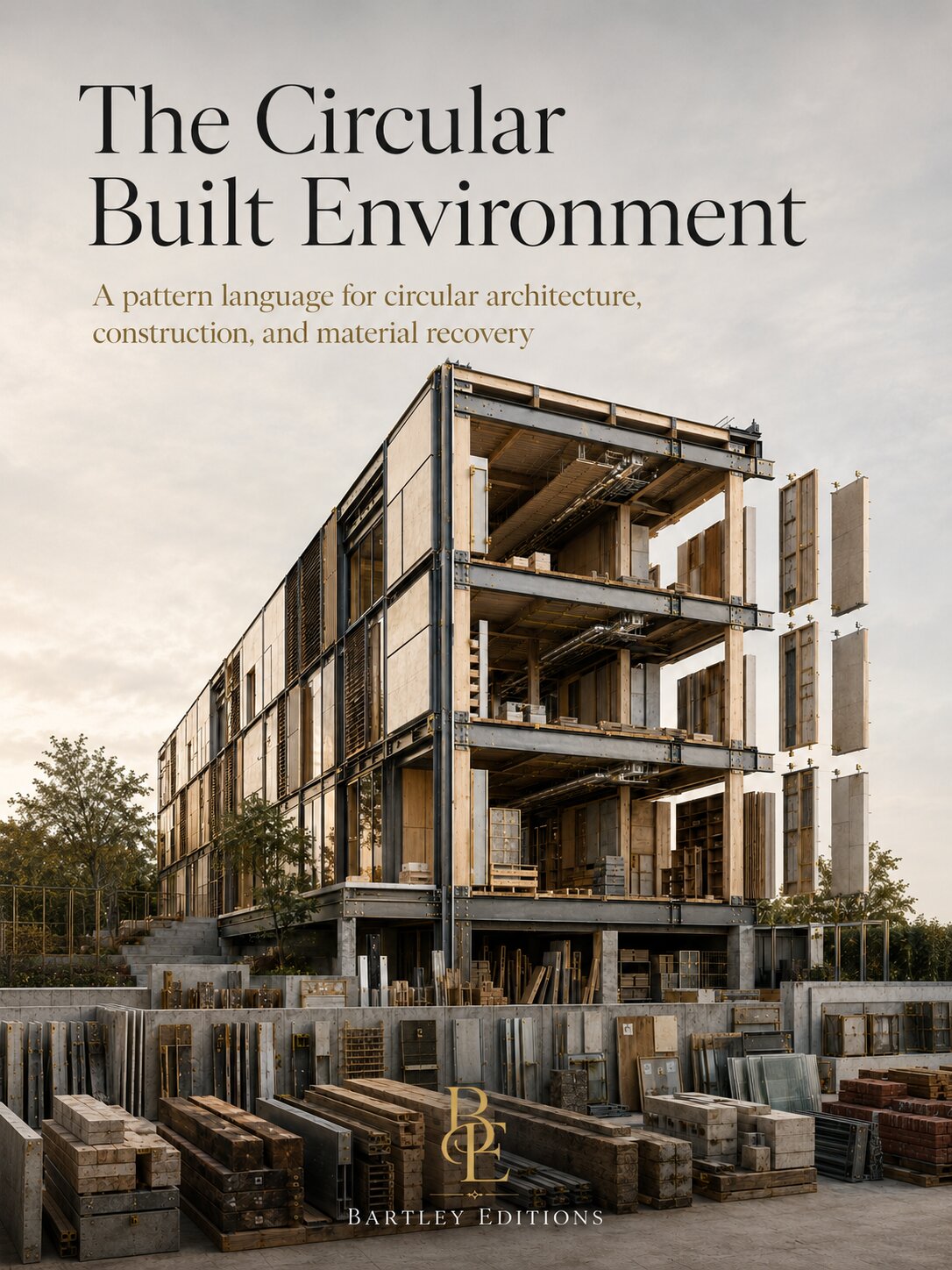
The Circular Built Environment is a field reference for circular-economy practice in architecture, construction, material recovery, and real-estate capital. It names the concepts, patterns, and antipatterns that practitioners currently learn from scattered playbooks, standards, pilot projects, and procurement documents.
The book treats every building as a future material bank. Each entry connects a physical move to its documentation, standards, contract, supply-chain, and finance consequences where those consequences matter.
Browse the Encyclopedia
Introduction — Includes , and more. View all 2 entries →
Foundations: The Circular-Economy Worldview Applied to Buildings — Establishes the conceptual ground: butterfly diagram, R-strategies, planetary bounds, the linear-construction baseline being replaced. Includes Butterfly Diagram (Technical and Biological Cycles), R-Strategies (R0–R9 / 9R Framework), Linear Construction (the “Take-Make-Demolish” Baseline), Embodied Carbon (vs Operational Carbon), Whole-Life Carbon Assessment, Buildings as Material Banks (BAMB), and more. View all 6 entries →
Design for Disassembly and Reversibility — The architectural and structural-engineering moves that make a building’s components recoverable, including connections, sequencing, and documentation. Includes Bolt Don’t Weld, Reversible Mechanical Connection, Layered Construction Sequencing, Connection Hierarchy Mapping, Disassembly-Ready Documentation Set, and more. View all 5 entries →
Material Passports and Building Data — The documentation, data-model, and platform layer (BAMB, Madaster, DPP, BIM integration) that turns physical buildings into queryable material banks. Includes Material Passport, Digital Product Passport (DPP) for Construction Products, Building Resource Passport (BRP), Material-Passport Schema and Interoperability, BIM-Linked Material Tracking, and more. View all 5 entries →
Modular, Volumetric, and Off-site Systems — Prefabricated assemblies whose factory-controlled construction is naturally compatible with disassembly, reuse, and reconfiguration. Includes Volumetric Modular Construction, Panelized Construction, Cross-Laminated Timber (CLT) and Mass Timber, and more. View all 3 entries →
Materials, Chemistry, and Bio-based Substrates — Cement, steel, glass, mass timber, hempcrete, mycelium, lime, and the chemistry of binders, finishes, and coatings as they bear on recovery. Includes Hempcrete and Bio-Based Wall Systems, Mycelium Composites in Construction, and more. View all 2 entries →
Lifecycle Extension: Adaptive Reuse, Layering, and Open Building — Patterns that multiply a building’s useful life through retrofit, conversion, and design for adaptability. Includes Adaptive Reuse, Shearing Layers (Six S’s), Long Life, Loose Fit, Open Building (Support and Infill), Adaptive-Reuse Feasibility Triage, and more. View all 5 entries →
Urban Mining and the Reuse Supply Chain — The operational discipline of recovering, certifying, and re-marketing reclaimed building components. Includes Reused Structural Steel, Recycled Concrete Aggregate (RCA) — and Its Limits, Salvaged Building Components Marketplace, Pre-Demolition Material Audit, and more. View all 4 entries →
Business Models, Contracts, and Performance — Product-as-a-service, façade leases, deconstruction contracts, performance-based agreements, and the warranty/liability and asset-ownership consequences. Includes Light-as-a-Service, Façade-as-a-Service, Deconstruction Contract, and more. View all 3 entries →
Standards, Certifications, and Regulation — ISO/TC 323, ISO 20887, Level(s), BREEAM, LEED, DGNB, C2C, Living Building Challenge, RICS WLCA, EU CPR/ESPR/Circular Economy Act. Includes ISO 20887 Design for Disassembly and Adaptability, EU Level(s) Framework, BREEAM Circularity Credits, LEED v5 Circularity Treatment, DGNB Circular-Building Module and Building Resource Passport, Cradle to Cradle Certified Product Standard, Revised EU Construction Products Regulation (CPR) Effective 2026, and more. View all 10 entries →
Capital, Finance, and the Bankability Gap — Green bonds, sustainability-linked loans, IFC guidelines, McKinsey/WEF retrofit-materials opportunity, the underwriting case for disassembly-credit instruments, the cost of capital for product-as-a-service models. Includes Bankability Gap (Circular Construction Finance), Green Bonds for Circular Construction, Sustainability-Linked Loans for Real Estate Decarbonization, Circular Retrofit Investment Case, IFC Harmonized Circular Economy Finance Guidelines (2025), and more. View all 5 entries →
Antipatterns: Where Circular Construction Goes Wrong — The recurring traps — disassembly-theory, downcycling-circularity, performance-contract risk dump, showcase-pilot trap, greenwashed material claims. Includes Disassembly-in-Theory, Downcycling-as-Circularity, Performance-Contract Risk Dump, Showcase-Pilot Trap, Greenwashed Material Claim, and more. View all 5 entries →